
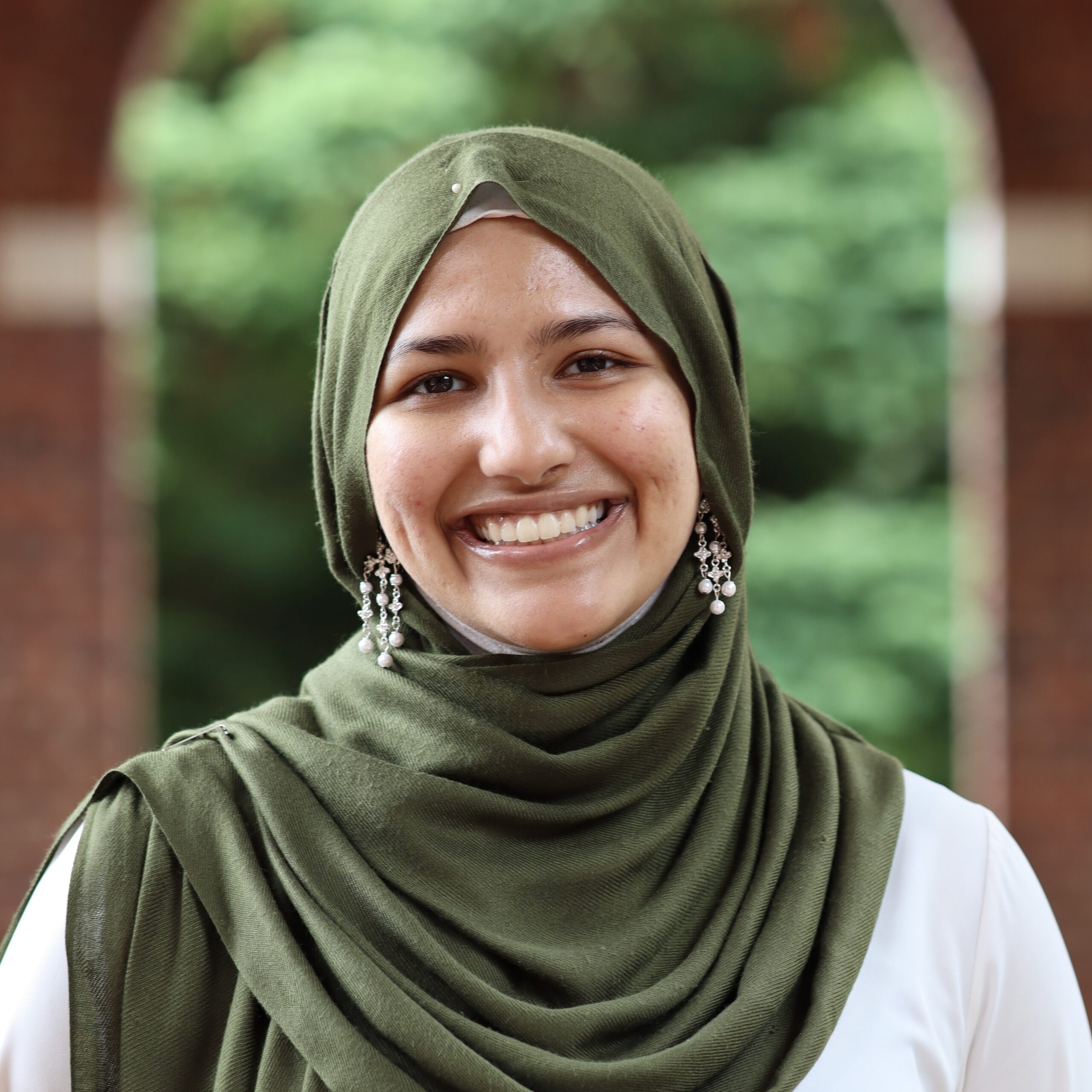
Dua Hussain, a Kessler Scholars graduate of Johns Hopkins University, had a dream of becoming a doctor that started during her childhood.
Growing up in Delaware, Dua watched her father regularly travel with her grandmother to Johns Hopkins Hospital for treatment after she was diagnosed with Amyotrophic Lateral Sclerosis (ALS). Those visits to Baltimore left an impression that would shape her future.
“In the second grade, I was like, ‘I want to go to Johns Hopkins, and I want to be a doctor!’” she said.
With parents who immigrated to the United States and placed a deep value on education they themselves had not been able to complete, that vision was nurtured and supported from an early age.
“My parents told me to ‘do whatever you want and we’ll figure it out,’ basically,” she said. “We’re very low-income, so it should have been a conversation of ‘how are we going to afford this?’” she said.
When it came time to apply to college, she—not surprisingly—made the choice to apply early decision to Johns Hopkins. The combination of strong financial aid and the opportunity to pursue her lifelong goal made the university a clear fit. But arriving on campus brought a new set of adjustments.
“I’m Muslim, and where I grew up, there were not many of us,” she said. “For the schools that I went to, the people did not share the same identity as me, and I would be questioned all the time.”
Moving to a city the size of Baltimore was a little overwhelming but also exciting. At Johns Hopkins, she was finally in a space where she no longer felt the need to explain the nuances of her background.
“I was so shocked at how much everyone knew,” she said. “I would say, ‘I have to go pray’ or ‘It’s Ramadan, and I’m fasting’ and I wouldn’t have to explain it. It was so life-changing.”
Still, the transition wasn’t without its challenges. Dua’s younger brother has Down syndrome and autism and has always been a central part of her life. Moving away meant leaving him and changing her role from that of a daily caretaker to a long-distance sister.
“It was sad, and it continues to be sad, but we’re a little more used to it now,” she said.
To aid in the transition, Dua found a space that fully brought together her academic interests and her personal identity—the Kessler Scholars Program. Encouraged by her academic advisor, she joined the program at a time when she was still trying to understand what it meant to be a first-generation college student.
“Kessler was the first time I met people who were first-generation,” she said. “I was able to talk to them about things my other friends didn’t really understand.”
The Kessler Scholars Program opened doors to allow her to mentor through the Pre-Orientation program, attend conferences across the country, and build relationships with other like-minded students.
This fall, Dua will take the next step toward her lifelong dream as she begins graduate school at Thomas Jefferson University’s Sidney Kimmel Medical College in Philadelphia, Pennsylvania. At the same time, she remains committed to storytelling, with hopes of becoming a published author and continuing to write for young readers.
“Being at the point that I am now is crazy to me,” she said. “It feels like I’ve been constantly climbing the steps toward something, and I can see the door now.”
Reflecting on her journey, Dua emphasizes the importance of community and curiosity. For first-generation students especially, the willingness to ask questions and build relationships can make all the difference.
“The biggest thing I’ve learned as a first-generation student is to always ask for help and to lean on the people around you,” she said. “Sometimes there are questions you don’t even know to ask, and the people around you will ask them for you.”