
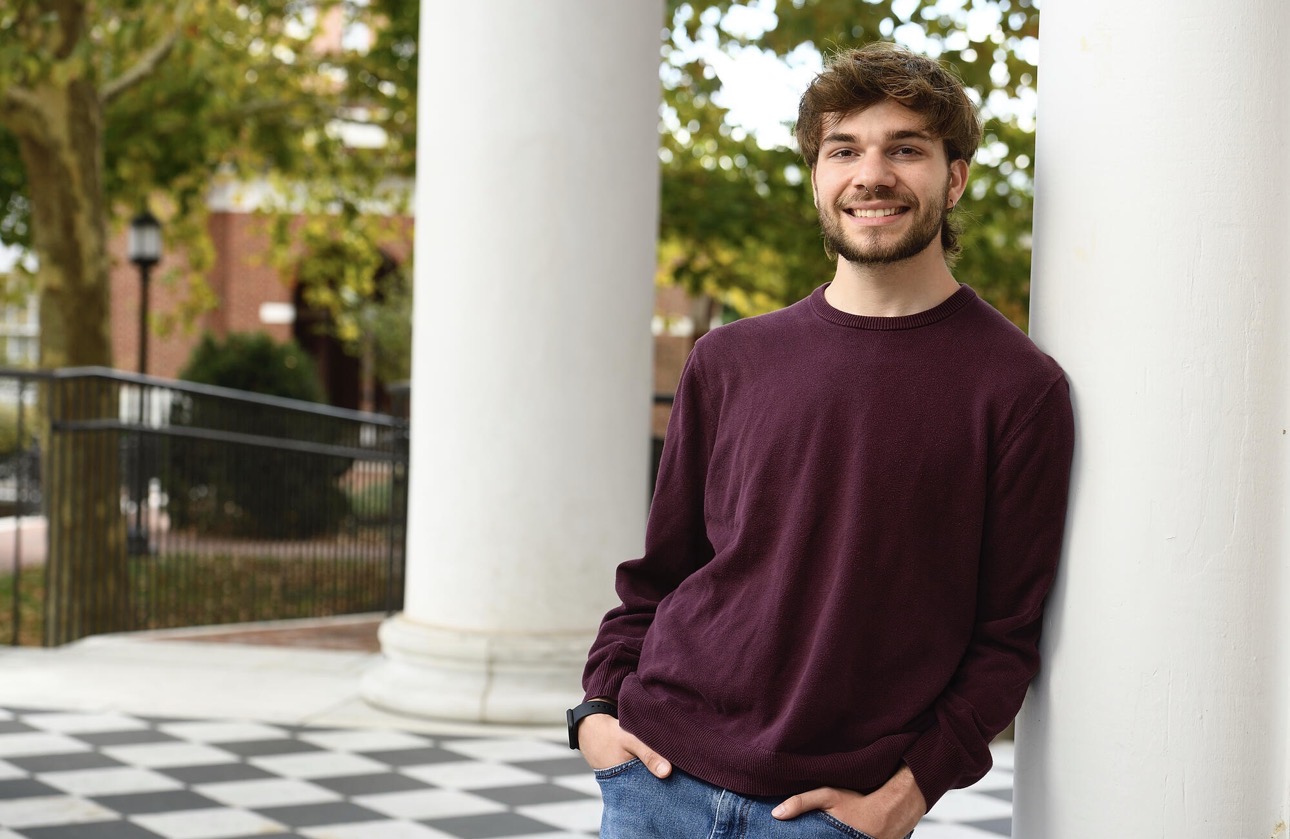
Growing up in La Pine, Oregon, Trace Terrell didn’t always see a clear pathway to institutions like Johns Hopkins University. As a first-generation student in a small town, he had little awareness of the college admissions process. But his deep commitment to mental health advocacy and community care helped shape his future interest.
“In high school, I was really involved with suicide prevention and mental health advocacy work,” he said.
Trace volunteered on a crisis hotline, supporting peers navigating school stress, depression, and other mental health challenges. As he began to explore colleges, Johns Hopkins University emerged as a natural fit. Known for having one of the top public health programs in the United States, it aligned closely with his aspirations.
“When I started thinking of what I wanted to do after high school, I just really wanted to help the community and as many people as possible,” he said.
Financial support and mentorship made that leap possible, giving him the confidence to pursue an opportunity far from home. Arriving on campus with just one suitcase, Trace faced a significant culture shock. Moving across the country alone, without a built-in support system, was both daunting and isolating.
“It was really scary,” he said. “I had never been somewhere by myself, so far away from family.”
The summer Pre-Orientation offered by the Kessler Scholars Program helped ease that transition. He connected with his cohort through a virtual introduction and then participated in the program’s Coin Ceremony, a signature event to welcome all first-year Kessler Scholars to the community.
“I remember going to the Coin Ceremony and that was just so cool,” he said. “It felt like there was this really specific community for me of people who understood what it’s like to be a first-generation student and the many challenges associated with that transition.”
Among his most memorable experiences was a cohort field trip to the Baltimore Comic-Con.
“I had never imagined I would be going to Comic-Con for any reason,” he said. “But, it was such a cool experience to build relationships and connections with other Kessler Scholars.”
Yet perhaps his most impactful experience came later, when he had the opportunity to give back. Serving as a peer mentor during the summer 2025 Pre-Orientation program, Trace supported the incoming cohort of Kessler Scholars as they transitioned to college life. Drawing from his own early experiences, he was intentional about showing up for others in those critical first weeks.
“There’s so much value in being able to relate to someone,” he said. “Especially at such a pivotal time in your life.”
As graduation approaches, Trace stands at an exciting crossroads. He was recently selected for the prestigious Johns Hopkins Meg Walsh Award, a $32,000 grant supporting independent international research. If accepted, he will spend six to nine months in Barbados conducting research on suicide prevention and crisis intervention. He has also been admitted to multiple graduate programs in public health and is considering pursuing a master’s degree in public health with a long-term goal of earning a Ph.D. in community psychology or epidemiology.
Looking ahead, Trace hopes to influence behavioral health policy at the federal or state level, working to expand access to high-quality mental health care.
His words of advice encourage future Kessler Scholars to fight the “imposter syndrome” commonly experienced by first-generation college students.
“Always put yourself out there and accept rejection and redirection,” he said. “Apply for things even when you don’t think you’re necessarily qualified.”